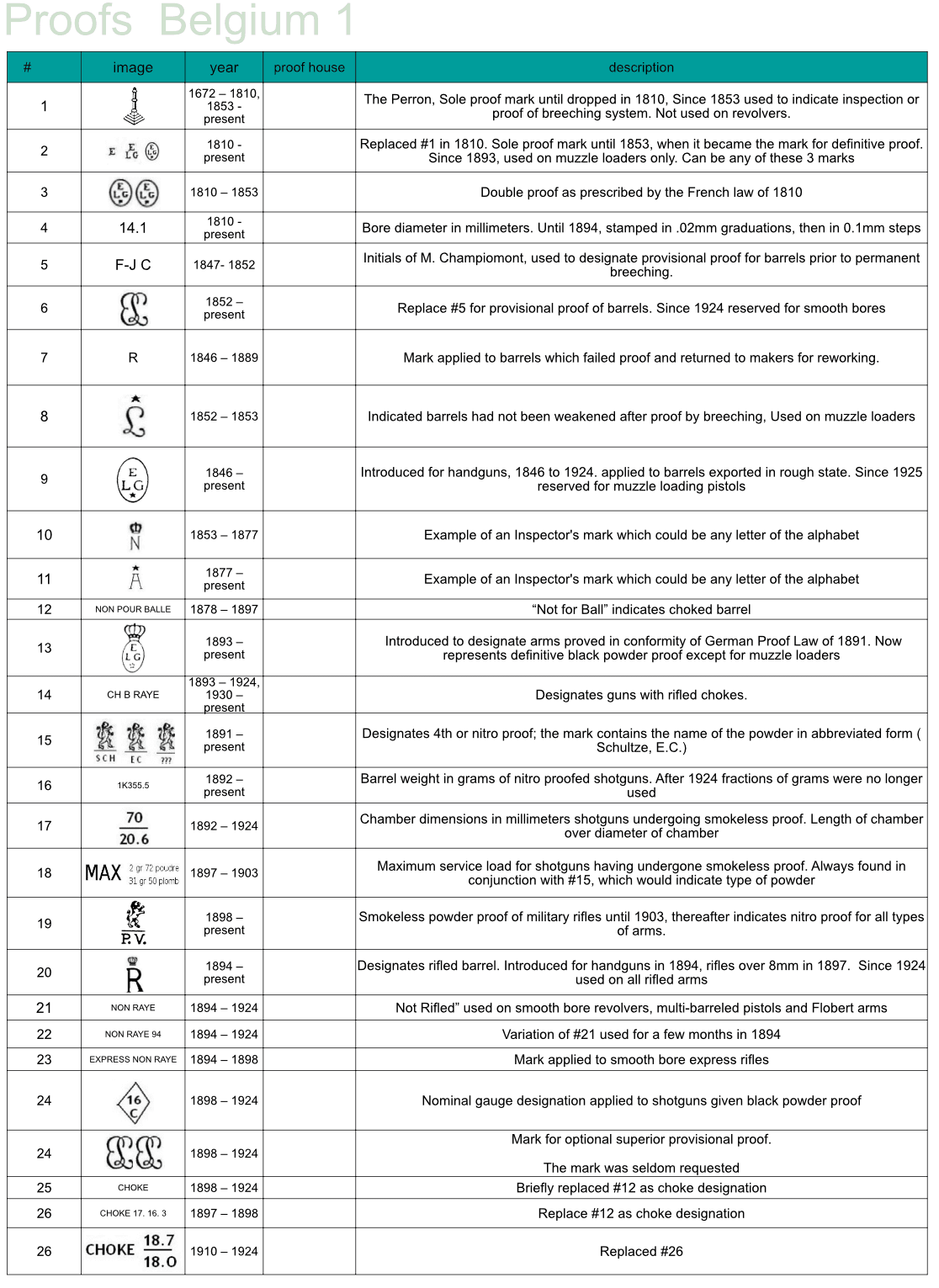
The principality of Liege was annexed in 1795 by the French Republic after the revolution of 1789. The Proofing of Firearms, until then not formally regulated, was then aligned with the rules imposed by Napoleon’s decree of 14th December 1810.
This decree fixed the Proof procedure as well as the working methods of the Proof Houses of the whole French Empire.
That same year the possibility of establishing a single institution for the proof of firearms in the northern part of the empire, in Liege, was discussed. Government and manufacturers agreed on the principle of testing and its methods, but a conflict arose on the type of marking. An “LE” stamp, for Liège Epreuve or “Liège Proven”, was suggested, but arms manufacturers wanted just the letter “E” in order to obscure the origin of the product. It was felt necessary to obscure the Liege origin in order to facilitate foreign dealers who sold products as their own. The “E”, often with a separate star was used between March 1810 and February 1811. At that date a stamp carrying the letters “E” and “LG” over a five-pointed star, in a vertical oval was introduced. Private test benches however continued to operate for a few decades.
The growth of the arms industry in the 19th century made it necessary to erect a large proofing facility in 1847. It was to be further expanded in 1909. The Liege proof house grew to be perhaps the most important of Europe.
In 1914 the proof house had to be closed when the First World War reached Liege, and it only reopened in February 1919.